

The president not only won’t denounce Russia, but he goes out of his way to avoid it—like when he thanked the Kremlin on Thursday for expelling U.S. diplomats.
a New York Times tally, Trump has attacked 351 separate people, places, and things on Twitter alone since July 2015.
The president has demonstrated that tendency this week, with his escalating, improvised threats against North Korea and his parallel assault on Mitch McConnell, his most important ally in Washington.
Those feuds make Trump’s refusal to criticize Russian President Vladimir Putin all the more conspicuous.
On July 30, Putin announced that Russia was forcing the U.S. State Department to reduce its staff in Russia by 755 people. (For the most part, those who were laid off were Russians working for the embassy, not American diplomats.) Trump, who often can’t let a provocation on cable news go unanswered for more than a few hours, was uncharacteristically quiet.
He finally broke his silence, after a fashion, on August 3, the day he signed a bill increasing sanctions on Russia in retaliation for interfering in the 2016 election. Trump had opposed the legislation, but it passed Congress with veto-proof majorities, leaving him little choice but to sign it. There are many reasons Russo-American relations are strained: Russian anger at expansion of NATO, longstanding global rivalries, the Russian annexation of Crimea and intervention in Ukraine, years of Russian human-rights abuses, and Russian tampering with the election. Trump chose to place blame for the rocky state of the relationship not on any of those issues, and certainly not on Putin, but squarely on Congress. Just for good measure, he tossed in an unrelated jab at the failure of an Obamacare repeal-and-replace plan:

I want to thank him because we’re trying to cut down our payroll, and as far as I’m concerned I’m very thankful that he let go a large number of people because now we have a smaller payroll. There's no real reason for them to go back. I greatly appreciate the fact that we’ve been able to cut our payroll of the United States. We’re going to save a lot of money.Was Trump speaking with tongue in cheek? It’s possible, but he didn’t smile when he said it. (The president has often tried to pass off apparently serious comments as jokes after the fact, in order to defuse situations.) The remark fits with his attempt to cut costs at the State Department and his disdain for traditional diplomacy.
The strange thing about Trump’s comments about Putin is not merely that he won’t criticize him, but that he goes out of his way to avoid it. The tweet about Russian relations and his remarks on Thursday were hardly the only times this has happened. And that’s even leaving aside Trump’s repeated praise for the Russian leader during the campaign, when he praised Putin’s leadership, suggested he’d allow the annexation of Crimea, and publicly called on Russia to hack Hillary Clinton’s emails.
Let’s draw a line between what Trump said on the campaign trail and what he’s said since the election. Although he had been briefed before November 8, it was after the election that he began getting full intelligence briefings on Russian interference. Since then, there has also been an increasing focus on interference among members of the public, press, and Congress. In other words, Trump has had many more incentives to distance himself from Russia. Instead, he’s continued to hold his fire.
He has also repeatedly declined to accept the idea that Russia meddled in the election, even though it is the conclusion of all the major intelligence agencies, and even though many of his top aides have said they blame Russia for hacking attacks. In June, he called the attacks “a big Dem HOAX.”
In early July, during a trip to Poland, he halfway accepted that Russia might have been behind them, then backed off the statement and worked to muddy the waters.
I think it was Russia, and I think it could have been other people in other countries. It could have been a lot of people. I said it very simply. I think it could very well have been Russia, but I think it could well have been other countries. I won’t be specific. I think a lot of people interfere. I think it’s been happening for a long time, it’s been happening for many, many years.Yet he added: “Nobody really knows. Nobody really knows for sure.”
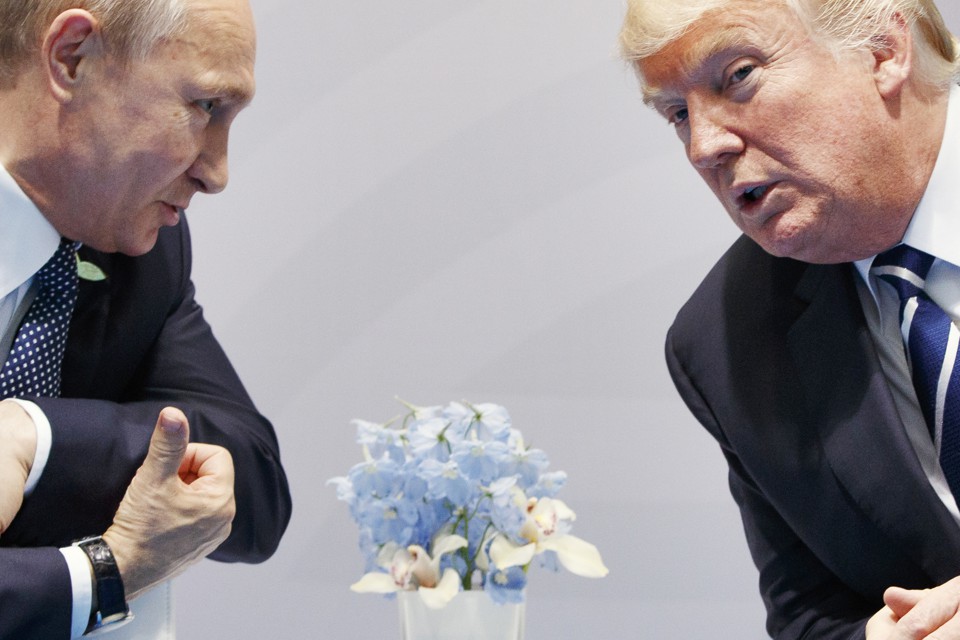
Later that week, Trump had his first face-to-face meeting with Putin, at the G20 summit in Hamburg, Germany. U.S. and Russian accounts of the meeting initially diverged, with the United States saying Trump had pressed Putin forcefully on the hacking, and Russia saying Trump had accepted Putin’s denials.
There is little obvious foreign-policy advantage. During the campaign and early in his presidency, Trump argued that the United States ought to launch a charm offensive in order to improve relations with Russia. Whether that was right or wrong, and whether Congress or someone else is to blame, that approach is obsolete today. As Trump, Secretary of State Rex Tillerson, and Russia have all admitted, relations are now at a low ebb.
Even if Trump fully believes that Putin is a spotless, admirable leader falsely accused of various crimes, it would be to his benefit to create some separation, and a matter as simple as expulsion of diplomats offers a good chance for Trump to stand up for his country. Putin, like any foreign leader, understands that sometimes a head of state has to shore himself up domestically and would surely interpret a few hostile words from Trump in that light. (Alternatively, even if one believes Trump is a bought-and-paid-for puppet of the Kremlin, why wouldn’t he publicly denounce Putin to buy himself some maneuvering room?)
In fact, his actions are making him look weak, but not in the way he thinks. His refusal to criticize Putin even in the case of diplomatic retaliation gives the impression that he is intimidated by the Kremlin and doesn’t have it in him to be tough. The president has cut off his nose to spite his face, and is now willing to cut off an ear or a lip if he must.
During his only press conference between the election and inauguration, on January 11, Trump fielded questions about his affection for the Russian leader.
“If Putin likes Donald Trump, guess what, folks, that’s called an asset, not a liability,” he said. “Now, I don’t know that I’m going to get along with Vladimir Putin. I hope I do. But there’s a good chance I won’t. And if I don’t, do you honestly believe that Hillary would be tougher on Putin than me? Does anybody in this room really believe that?”
Seven months later, it seems clear that she couldn’t have been any less tough.

No comments:
Post a Comment