Subscribe in a reader
Showing posts with label Movies. Show all posts

Wednesday, 15 March 2017

President Donald Trump has unveiled an updated executive order

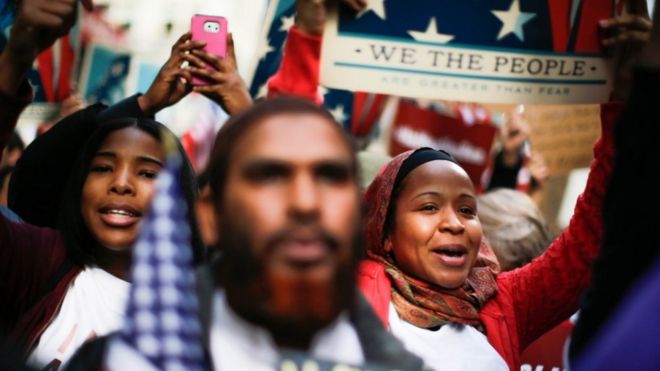
People take part in a rally called "I Am A Muslim Too" in a show of solidarity with American Muslims at Times Square on 19 February 2017 in New York City

Image copyrightGETTY IMAGES
Image captionProtesters have been rallying against the travel ban across the US

President Donald Trump has unveiled an updated executive order, reviving his bid to ban refugees and immigrants from several mostly Muslim countries from entering the US.
His previous order, which sparked mass protests and confusion at airports, was halted by the courts.
The new, updated one has also been challenged - seven states have joined an effort to block it.
But how is the new order different - and what is still not clear?

Who will be affected?

The original order barred people from seven majority-Muslim countries - Iran, Iraq, Syria, Yemen, Somalia, Sudan and Libya - from entering the US for 90 days. It also halted refugee resettlement for 120 days and banned Syrian refugees indefinitely.
However, many questions remained about the detail of the ban. How would it affect people from the seven countries who were also permanent legal US residents? And what about people who already had US visas or dual nationality?

Grey line

More on Trump's travel ban


Grey line

The head of Homeland Security, Mr Kelly, said the new version of the travel order would not prevent foreign nationals with either work visas or Green Card permanent residency permits from re-entering the United States. Nor would it affect foreign travellers already flying to the US when the order takes effect, he added.
It will also no longer include Iraq, after it agreed to "increase cooperation" with the US government, according to a fact sheet which was circulating ahead of the announcement.
Attorney General Jeff Sessions said of the six countries remaining, three were state sponsors of terrorism and the other three had lost control, increasing the risk of a terrorist emerging from their territory. They will still be banned for 90 days.
The refugee programme will be suspended for 120 days, with only those who are already formally approved and scheduled allowed to enter. The fact sheet also suggests the number of refugees for the year until October will be capped at 50,000, some 35,000 shy of the previous 12 months.
But the order no longer demands that border authorities single out and reject Syrian refugees when processing new visa applications.

How will it be implemented?


Media captionWashington Attorney General Bob Ferguson said the travel ban was adopted with "little thought, little planning, little oversight"

The original order triggered a lot confusion and uncertainty. Scores of people were detained at airports or in transit, with many more stranded or forced to return to where they came from.
US government officials complained that the roll-out had been chaotic, and there was a lack of guidance before the policy was announced on 27 January.
The new order will only come into effect on 16 March, allowing officials time to put structures in place.
It will also honour valid visas from the six countries during the 90-day ban.
Mr Kelly said this time around, his department would ensure that "there's no-one... caught in the system of moving from overseas to our airports, which happened on the first release".
He said there would be a "short phase-in period" and immigration officials would "make sure that people on the other end don't get on airplanes".
The impact on US embassies as well as airports and border crossings will be closely watched.

Will it answer legal questions?

The president's spokesman says it will. Sean Spicer told reporters last month that the second order would be "tailored to achieve the same goals" as the first "but in accordance with what the [appeals] court said".
One of the concerns that the judges in San Francisco cited when they refused to reinstate the original ban was the way it was rolled out. They said the justice department had failed to show that the executive order gave enough "notice and a hearing prior to restricting an individual's ability to travel".
Donald TrumpImage copyrightGETTY IMAGES
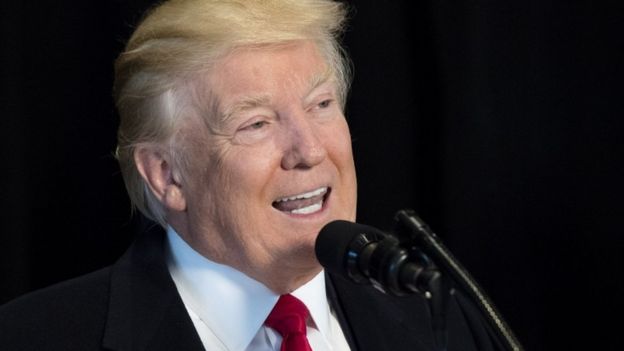
Image captionDonald Trump hit out at judges who refused to reinstate his ban

Legal experts will ask whether the Trump administration can prove that the order is needed to keep the country safe.
In its ruling, the appeals court judges found "no evidence that any alien from any of the countries named in the order" had committed a terrorist attack in the US.
Meanwhile, the exclusion of Syrians in January's order was also problematic. The Immigration and Nationality Act says no person can be "discriminated against in the issuance of an immigrant visa because of the person's race, sex, nationality, place of birth or place of residence".
Several states have challenged the new order.
Oregon - said the order hurts residents, employers, universities health care system and economy
Washington - it has "same illegal motivations as the original" and harms residents, although fewer than the first ban
Minnesota - questioned the legality of the move, suggesting the Trump administration can't override the initial ban with a fresh executive order
New York - "a Muslim ban by another name", said the attorney general
Massachusetts - new ban "remains a discriminatory and unconstitutional attempt to make good on his campaign promise to implement a Muslim ban"
Hawaii - argued it would harm its Muslim population, tourism and foreign students
California - says order is an attack on people based on their religion or national origin

Will it be a Muslim ban?


Media captionMuslim students on Trump ban: 'I don't belong here'

The fact that the countries included in the original ban are all majority Muslim lends weight to the critics's argument that the order is "anti-Muslim".
On 14 February, a US district judge in Virginia ruled the the ban was unconstitutional because it had religious bias at its heart.
In a bid to address religious discrimination issues, the new order removes a particular section that said refugees' claims should be prioritised "on the basis of religious-based persecution, provided that the religion of the individual is a minority religion in the individual's country of nationality".
Mr Trump previously said priority should be given to persecuted Christians.

Will opponents continue to fight it?

President Trump's hardline policies on immigration have sparked protests and several lawsuits around the country.
After the appeals court refused to reinstate his ban, Mr Trump tweeted: "Just cannot believe a judge would put our country in such peril. If something happens blame him and court system. People pouring in. Bad!"
White House spokesman Sean Spicer has said that Mr Trump was still confident his initial order would prevail.
But until that time, "we will have a dual track system and make sure we implement a second executive order", he said.
The idea of a second order does not seem to have quelled opposition. Fresh demonstrations are being organised and civil rights groups have said they will continue to challenge the president in the courts.
It is likely the Trump administration will now be asked to justify two orders instead of one.

Trump tracker: How much has the president achieved so far?

President Trump on the phone in the Oval Office of the White House - 28 January 2017

Image copyrightAP

Donald Trump came into office promising to change the face of American politics and transfer power "back to the people".
After four weeks in the White House, he said "incredible progress" had been made, having signed some two dozen executive actions and put his signature to several bills.
But he has also been forced to fire his scandal-hit national security adviser and an acting attorney general, who defied his seven-nation travel ban, which later suffered an appeals court defeat.
So what has President Trump achieved so far? In the weeks and months to come, we'll be tracking the progress he makes on his agenda and how it is received by the American public.

What executive actions has Trump taken?

One way President Trump is able to exercise political power is through unilateral executive orders and memoranda, which allow him to bypass the legislative process in Congress in certain policy areas.


He wasted little time in taking advantage of this, moving to withdraw from the Trans-Pacific Partnership trade deal, cutbusiness regulations and push ahead with the construction of two controversial pipelines.
While it may appear that he has been signing executive actions at an unprecedented rate, he has signed less than President Obama did during the same period in office.

Chart showing the number of executive orders signed by President Trump compared to President Obama
President Trump has used several of these actions to deliver on some of his campaign promises, but many of his promises cannot be fulfilled by executive action alone.
For example, his first executive order was designed to limit the effect of the Affordable Care Act, better known as Obamacare, but his promise of repealing and replacing it can only be enacted by Congress.

How are his approval ratings?

When Mr Trump took the oath of office on 20 January he did so with the lowest approval rating of any incoming president.
He dismissed those polls as "rigged" but the strength of the opposition to him was evident when hundreds of thousands of people took to the streets the day after his inauguration.
Most presidents begin their term with strong approval numbers, but President Trump has bucked that trend. While both George W Bush and Barack Obama were enjoying approval numbers in the 60s after one month in office, Mr Trump was around the 40% mark.

Graphic showing the approval ratings of the last four US presidents after they had been in office for one month
Mr Trump won the election with low approval numbers so it's unsurprising they're still low, but the scandal over his team's contacts with Russia and his controversial travel ban have kept them falling.
Still, Mr Trump's attempts to cut business regulation and his hard line on immigration have impressed many of his supporters - we spoke to some who said he was doing "a fabulous job"
Do his approval numbers matter? Maybe not, for now.
Republicans control both the House and Senate so in theory he can pursue his legislative agenda without worrying about his ratings - as long as he keeps his Republican colleagues on side.
But if his ratings stay low or fall further, expect some dissenting voices to emerge in the party as Republicans start to worry about midterm elections in 2018.

What has been done on healthcare?

Healthcare was always going to be an early test for President Trump and the Republican Party.
President Obama's Affordable Care Act helped more than 20 million previously-uninsured Americans to finally get health cover - but Mr Trump said he would act quickly to "repeal and replace" it.
Republicans eventually unveiled their long-awaited draft healthcare bill at the beginning of March, with House Speaker Paul Ryan praising it as "monumental, exciting conservative reform."
President Trump backed the bill but it quickly received a damning assessment by the Congressional Budget Office (CBO), a nonpartisan group of budget analysts and economists.
The CBO analysis suggested that an estimated 14 million people would lose their insurance coverage in 2018 under the Republican plan and that number would rise to 24 million by 2026.

Chart showing the number of uninsured Americans. US Census Bureau shows the number dropped from 16% in 2006 to about 10% in 2016. Projections by the Congressional Budget Office suggest that that figure could jump to 19% by 2026 under Republican plans
Health and Human Services Secretary Tom Price said the Trump administration "strenuously disagreed" with the report's findings on the number of people who would lose coverage and insisted it would cover more individuals at a lower cost.
But it has received fierce criticism from several quarters, including many in the Republican party who labelled it "Obamacare 2.0" because they believe the plan has too much government involvement.

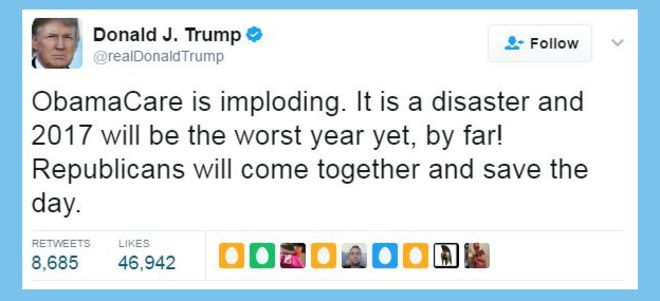
Tweet by Donald Trump

Despite President Trump's initial backing, he has suggested it may face some changes before it is passed, saying the legislation was now open for "review and negotiation".
Obamacare has faced several problems since it was introduced in 2010 and premium hikes in 2016 helped the Republicans frame it as a failure during the election campaign.
Several recent polls have suggested that support for the scheme is actually growing.

How is the economy faring under Trump?

When Barack Obama became president in 2009, the US was in the midst of its worst recession since the 1930s, with the economy shedding 800,000 jobs in his first month.
But after a few dips later that year, the US economy saw its longest ever period of job creation. In total, 11.3 million jobs were created under President Obama.
Mr Trump has previously dismissed those numbers as "phony" and after his inauguration he described the economy as a "mess".
But when the new monthly report was released in March, showing 235,000 jobs had been added to the workforce in February, White House press secretary Sean Spicer said it was "great news for American workers".

Chart showing the number of jobs lost or created in the US since 2005
During the campaign, Mr Trump vowed to create 25 million jobs over 10 years and become "the greatest jobs president... ever".
He also accused Mexico and China of stealing millions of jobs and vowed to "bring our jobs home". But research suggests most of the manufacturing jobs that America has shed in recent years have been lost to increased automation at factories, rather than companies moving abroad.
We'll be keeping track of the monthly jobs report to see what progress he makes and we'll also be paying close attention to the manufacturing industry.
In the short term, however, President Trump has cited the stock market as a sign that his policies are already having an effect on the economy, saying there has been a "tremendous surge of optimism in the business world".

Chart showing how the S&P 500 has fared since Donald Trump won the election
The Dow, S&P 500 and Nasdaq indexes all closed at record highs on 15 February in a partial sign at least that investors were encouraged by Mr Trump's planned infrastructure projects, deregulation and tax cuts.
But the president will need to avoid the backlash that followed his ban on immigrants coming into the US from seven mainly Muslim countries if he wants the stock market to continue hitting new highs.
All of the three major indexes fell slightly after Mr Trump's controversial executive order caused protests at airports across the country - and Silicon Valley lashed out at the president as well.

Has Trump moved to cut illegal immigration?

Immigration was President Trump's signature issue during the election campaign and he has signed a number of executive orders designed to fulfil his promises.
One of his first orders declared that the US would build a "physical wall" or similar "impassable physical barrier" - to the delight of all of those Americans who spent 2016 chanting: "Build the wall!"
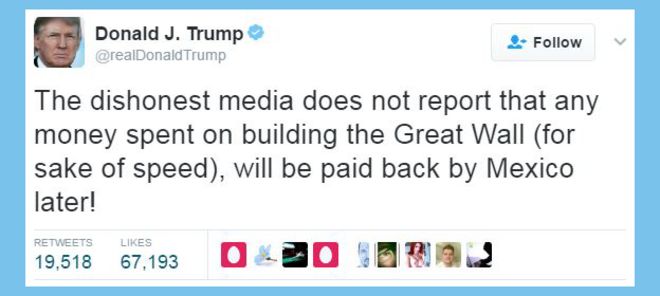
It remains to be seen how Mr Trump will pay it, although he has repeatedly insisted that the US will recoup the costs from the Mexican government, despite their leaders saying otherwise.
There is already some 650 miles of fencing along the border, but we'll monitor what progress President Trump makes in turning it into what he has called the "Great Wall".

Tweet by Donald Trump

Mr Trump used another order on border security to say 10,000 more immigration officers would be hired to track down illegal immigrants. But this will be a long process and newly appointed Homeland Security Secretary John Kelly said it was unlikely to happen "within the next couple of years".
The new president's talk of a crackdown on illegal immigrants makes it sound as if they had an easy ride under President Obama, but there is plenty of evidence to suggest the opposite is true.
Between 2009 and 2015, the Obama administration deported more than 2.5 million people - most of whom had been convicted of some form of criminal offence or were recent arrivals - leading some to label President Obama the "deporter-in-chief".

Chart show the number of illegal immigrants being deported from the US
While President Trump is yet to change US immigration laws, he did sign two memos on 20 February that instructed immigration officers to take a much tougher approach towards enforcing existing measures.
The new policy is so broad as to include just about every class of undocumented immigrant - more than 11 million by most estimates.
Press Secretary Spicer said Mr Trump "wanted to take the shackles off" immigration officials but insisted the move would not mean mass deportations.
The Immigration and Customs Enforcement agency has launched a series of raids across the country since Mr Trump was elected, but it's still too early to say if deportation arrests have increased.